
Loading your cart…
Botanical Extracts, Herbal Powders, Leaves, Medicinal Plants, Natural Oils, Seeds and Nuts
Neem
Azadirachta indica A.Juss
- Hindi
- नीम
- Sanskrit
- Nimba (निम्ब)
Content reviewed by Dr Kanhaiya L Yadav, Doctor on November 9, 2026 Last updated November 9, 2026
Neem (Azadirachta indica) is an evergreen tree traditionally used in India. Its leaves, bark, flowers, fruits and seeds are used in different botanical and personal care preparations. Learn about Neem’s botanical identity, plant parts, naturally occurring compounds, traditional uses and ingredient forms.
Overview
Neem (Azadirachta indica)
Introduction
Neem (Azadirachta indica A.Juss.) is an evergreen tree belonging to the Meliaceae family. It is native to the Indian subcontinent and is widely grown in tropical and subtropical regions. Neem has a long history of traditional use in India, particularly in traditional plant-based practices and personal care preparations.
Different parts of the neem tree, including its leaves, bark, flowers, fruits and seeds, have been used in traditional preparations. However, these plant parts have different compositions and applications and should not be treated as interchangeable ingredients.
Botanical Information
- Common Name: Neem
- Botanical Name: Azadirachta indica A.Juss.
- Family: Meliaceae
- Plant Type: Evergreen tree
- Primary Ingredient Forms: Dried leaves, leaf powder, leaf extracts and seed oil
- Plant Parts Used: Leaves, bark, flowers, fruits and seeds
Plant Description
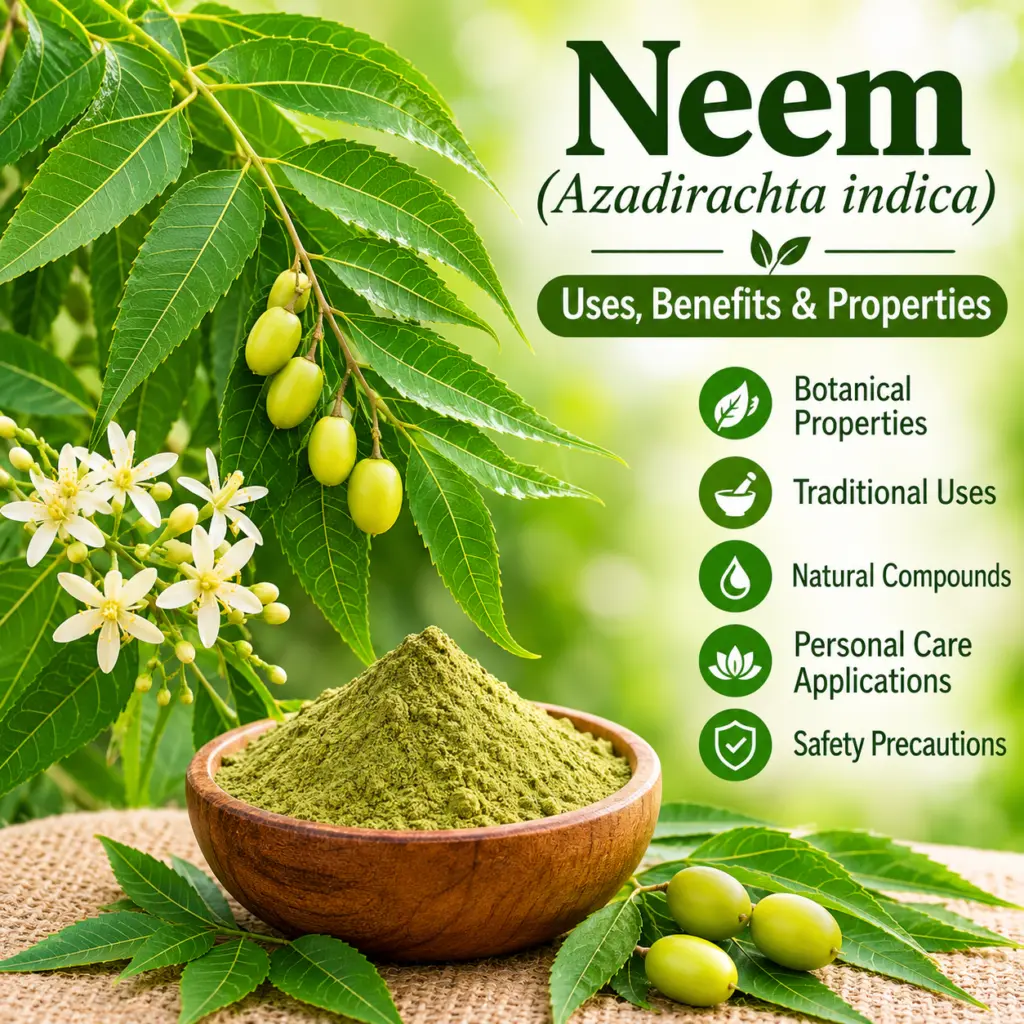
Neem is a medium to large evergreen tree with a spreading crown and a relatively short trunk. Its leaves are compound, with several elongated leaflets that have serrated edges. The tree produces small, fragrant, white flowers arranged in clusters. Its fruits are smooth, oval-shaped drupes that generally turn yellow when ripe and contain a seed.
Neem is known for its ability to grow in warm climates and is commonly found in gardens, agricultural areas and roadside plantations across India.
Parts of the Neem Plant
Different parts of the neem tree are used for different traditional and commercial purposes:
- Leaves: Used in traditional preparations and some botanical personal care products.
- Bark: Traditionally used in certain plant-based preparations.
- Flowers: Used in some regional food and traditional preparations.
- Fruits: Used in traditional applications and for seed collection.
- Seeds: The source of neem seed oil, which has a different composition from neem leaf powder.
The ingredient description should always identify the actual plant part used in a particular formulation.
Neem Leaves and Their Natural Composition
Neem leaves contain naturally occurring plant compounds, including various flavonoids, phenolic compounds and limonoids. The quantity and composition of these substances may vary depending on the plant’s growing conditions, maturity, harvesting time, processing and extraction method.
Neem leaf powder is generally prepared by collecting, drying and grinding neem leaves. It is different from neem seed oil, which is obtained from the seeds and has a distinct chemical composition.
Traditional Background
Neem has been an important tree in Indian traditional knowledge for generations. Its leaves and other plant parts have been mentioned in traditional practices and used in various household and personal care preparations.
Traditional uses include preparations involving neem leaves, botanical pastes, hair and scalp care practices, and cleansing applications. These historical uses describe cultural practices and do not establish that neem can diagnose, treat, cure or prevent any disease.
Traditional and Common Uses
Neem has traditionally been used in several ways:
- Preparation of herbal pastes using neem leaves.
- Inclusion in traditional bathing and cleansing practices.
- Use in certain hair and scalp care preparations.
- Inclusion in selected botanical soaps and personal care formulations.
- Use of neem seed oil in specific traditional and commercial applications.
- Use of dried neem leaves and leaf powder in traditional preparations.
The suitability of neem depends on the plant part, ingredient grade, concentration and intended application.
Neem in Personal Care
Neem is used as a botanical ingredient in selected personal care formulations, including soaps, cleansers, skin care products and hair care preparations.
In cosmetic formulations, neem may be included for its botanical identity, traditional background and naturally occurring plant compounds. Its performance and suitability depend on the complete formulation, ingredient quality and method of use.
The presence of neem in a cosmetic product should not be interpreted as proof of a medical or therapeutic benefit.
Properties and Characteristics
Neem is recognised for the following botanical and ingredient characteristics:
- Evergreen tree belonging to the Meliaceae family.
- Compound leaves with serrated leaflets.
- Naturally occurring flavonoids, phenolic compounds and limonoids.
- Long history of traditional use in India.
- Available in different ingredient forms, including leaf powder, extracts and seed oil.
- Different neem plant parts have different chemical compositions and uses.
These characteristics describe the plant and its ingredients rather than guaranteed effects in finished products.
Scientific Research
Neem has been investigated in laboratory and animal studies, as well as in some human research involving particular preparations and formulations. However, research findings cannot automatically be applied to every neem ingredient or finished cosmetic product.
The evidence available for neem varies by plant part, extract type, concentration and intended use. More well-designed human studies are needed to establish the safety and effectiveness of many proposed applications.
Traditional use and laboratory findings should not be presented as proof that neem treats or prevents diseases.
Ingredient Quality
The quality of neem ingredients can depend on several factors:
- Correct botanical identification of Azadirachta indica.
- Verification of the plant part used.
- Proper harvesting, drying and processing.
- Protection from contamination, moisture and foreign matter.
- Appropriate testing and quality documentation.
- Suitability of the ingredient grade for its intended application.
Neem leaf powder, neem extracts and neem seed oil should be clearly identified and sourced separately.
Storage Information
Neem leaf powder should be stored in a clean, dry and airtight container, away from direct sunlight, heat and moisture. Neem extracts and neem seed oil should be stored according to their supplier’s recommendations and the relevant product specifications.
Always follow the storage instructions and expiry information provided on the ingredient or finished product packaging.
Precautions
Neem ingredients are not all suitable for the same applications. Neem leaf powder, extracts and seed oil have different compositions and safety considerations.
For cosmetic use, follow the manufacturer’s recommended concentration and application instructions. Avoid contact with eyes and sensitive mucous membranes unless the formulation is specifically designed for that purpose. A patch test may help identify individual skin sensitivity.
Do not assume that neem products are safe for oral consumption. Neem seed oil and concentrated neem preparations should not be swallowed unless specifically directed by a qualified healthcare professional. Safety information during pregnancy and breastfeeding is limited, particularly for oral and concentrated preparations.
People with known sensitivity to neem should avoid products containing it. Discontinue use if irritation or an unexpected reaction occurs.
Important Information
This ingredient profile provides general botanical, traditional and scientific background about neem. It is intended for educational and ingredient-information purposes only. It does not replace professional medical advice.
The actual composition, concentration, plant part and directions for use must always be checked on the relevant product’s ingredient list and packaging.
How it has been used traditionally Traditional use
Neem (*Azadirachta indica* A.Juss.) has a long history of traditional use in India and other parts of South Asia. Different parts of the neem tree, including its leaves, bark, flowers, fruits and seeds, have been used in traditional household practices, personal care preparations and agricultural applications.
In Indian traditions, neem leaves have been used in seasonal and household customs, while neem twigs have traditionally been used for oral cleaning. Neem oil and leaf-based preparations have also been used in various traditional external applications.
Neem has an important place in traditional Indian knowledge systems, including Ayurveda. Traditional practices vary by region, preparation method and plant part. These historical uses describe cultural and traditional practices and should not be interpreted as proof of medical effectiveness.
- Neem (*Azadirachta indica* A.Juss.) has traditionally been used in India and other regions for household, personal care and agricultural purposes. Different parts of the neem tree are used in different ways depending on local traditions and preparation methods.
- ### Traditional and Common Uses
- 1. **Traditional Personal Care:** Neem leaves and neem-derived ingredients have traditionally been included in various personal care preparations.
- 2. **Oral Hygiene Practices:** Neem twigs have historically been used in some regions as traditional chewing sticks for cleaning teeth.
- 3. **Skin Cleansing Preparations:** Neem leaf-based preparations and extracts are used in selected traditional and modern cleansing formulations.
- 4. **Hair Care Products:** Neem-derived ingredients may be included in shampoos, hair cleansers and other hair care formulations.
- 5. **Soap and Cleansing Products:** Neem leaf extracts and other neem-derived ingredients are used in some botanical soaps and personal care products.
- 6. **Traditional Household Practices:** Neem leaves have been used in various regional household customs and traditional preparations.
- 7. **Agricultural Applications:** Neem seed-derived products, particularly neem oil and neem-based extracts, are used in agricultural formulations and pest-management practices.
- 8. **Botanical Formulations:** Neem leaves, bark, seeds and other plant parts are used as raw materials in different traditional and botanical preparations.
- ### Important Information
- Neem leaves, neem leaf powder, neem leaf extract and neem seed oil are different ingredient forms. Their composition and applications vary according to the plant part and processing method.
- These uses describe traditional practices and common ingredient applications. They do not establish that neem treats, cures or prevents any disease.
Traditional use describes how a plant has been used over time. It is not evidence that it works.
Properties
Botanical information General botanical information
- Botanical name
- Azadirachta indica A.Juss
- Plant family
- Meliaceae
- Plant parts used
- Bark, Leaf, Root, Seed, Whole plant
- Origin
- Indian subcontinent and surrounding regions
- Other regional names
- Hindi: Neem (नीम); Sanskrit: Nimba (निम्ब); Bengali: Neem (নিম); Gujarati: Limdo (લીમડો); Marathi: Kadunimb (कडुनिंब); Tamil: Vembu (வேம்பு); Telugu: Vepa (వేప); Kannada: Bevu (ಬೇವು); Malayalam: Aryaveppu (ആര്യവേപ്പ്); Punjabi: Nimm (ਨਿੰਮ); Urdu: Neem (نیم)
Neem (*Azadirachta indica* A.Juss.) is a medium-sized to large evergreen tree belonging to the family Meliaceae. It has a straight trunk, spreading branches and a rounded crown. Its compound leaves consist of several green, serrated leaflets arranged along a central stalk. Neem produces small, fragrant, white flowers in clusters and smooth, oval-shaped fruits that turn yellow when ripe. Each mature fruit generally contains a single seed. The tree is widely cultivated in tropical and subtropical regions and is well adapted to warm climates.
What research says Scientific research
Scientific research on this ingredient is limited (laboratory, animal or small studies). It does not show that the ingredient has these effects in people.
## What Research Says About Neem (Azadirachta indica)
Scientific research on Neem (*Azadirachta indica* A.Juss.) has investigated its leaves, bark, seeds, seed oil and different plant extracts. These studies have examined the plant's naturally occurring compounds and their biological activities.
### 1. Laboratory Research
Laboratory studies have investigated neem extracts and isolated compounds, including limonoids, flavonoids and other phytochemicals. Some studies have reported antimicrobial and other biological activities under experimental conditions.
However, laboratory findings do not establish that the same effects occur in humans or that neem products are effective treatments.
### 2. Animal Research
Some animal studies have examined different neem preparations and their biological effects. These findings provide preliminary research information but cannot be directly applied to human health.
### 3. Human Research
Human research on neem is limited and varies according to the plant part, preparation, concentration and intended application. Available studies are not sufficient to establish broad health claims for neem leaves, powders, extracts or seed oil.
### 4. Research on Different Neem Ingredients
- **Neem Leaves:** Research has investigated their phytochemical composition and biological activities, mainly in laboratory and preliminary studies.
- **Neem Leaf Extract:** Studies have examined extracts for different experimental biological activities. Results depend on the extraction method and composition.
- **Neem Seed Oil:** Research has investigated its chemical composition and applications, including certain topical and agricultural uses.
- **Neem Bark:** Some studies have examined its naturally occurring compounds and experimental properties.
These ingredients are chemically different and should not be treated as interchangeable.
### 5. Limitations of Current Evidence
Research findings vary because studies use different neem plant parts, extraction methods, concentrations and experimental models. Many reported findings come from laboratory or animal research rather than well-designed human clinical trials.
More high-quality human research is needed to establish the safety, effectiveness and appropriate use of specific neem preparations.
### Overall Scientific Evidence
Neem has been investigated in scientific research, particularly through laboratory and animal studies. However, current evidence does not establish that neem or its different preparations treat, cure or prevent diseases.
Traditional uses should be understood separately from scientific findings. Product-specific information should be based on the actual ingredient list, formulation and verified product documentation.
How it is used
Common forms: Dried plant, Extract, Fresh plant, Oil, Powder
Neem (*Azadirachta indica* A.Juss.) is used in personal care formulations in different forms, depending on the plant part and processing method.
Common applications include:
- **Soaps and Cleansers:** Neem leaf extracts and other neem-derived ingredients may be included in selected soap and cleansing formulations.
- **Skin Care:** Neem-derived extracts are used in some creams, lotions and botanical skin care preparations.
- **Hair Care:** Neem extracts may be incorporated into shampoos, hair cleansers and other hair care formulations.
- **Personal Care Powders:** Dried neem leaf powder may be used as an ingredient in selected traditional and cosmetic preparations.
- **Botanical Oils:** Neem seed oil is used in certain external-use personal care formulations.
Neem leaf powder, leaf extract and neem seed oil are different ingredients and are not interchangeable. Their suitability depends on formulation, concentration and intended application.
Always follow the directions provided on the individual product page and packaging. This section describes general ingredient applications, not instructions for using a specific product.
Storage
Neem-derived ingredients should be stored under suitable conditions to help maintain their quality and stability. Storage requirements vary depending on whether the ingredient is a dried powder, liquid extract or botanical oil.
### General Storage Guidelines
- **Neem Leaf Powder:** Store in a cool, dry place in a tightly sealed, moisture-resistant container.
- **Neem Leaf Extract:** Follow the manufacturer's recommended storage conditions, as requirements depend on the extraction method and formulation.
- **Neem Seed Oil:** Keep in a tightly closed container, protected from excessive heat, direct sunlight and contamination.
- **Neem Bark and Other Dried Plant Materials:** Store in clean, dry and well-sealed packaging.
### Important Storage Considerations
- Protect ingredients from moisture and excessive humidity.
- Avoid prolonged exposure to direct sunlight and high temperatures.
- Use clean, dry utensils when handling powders.
- Keep containers properly closed after use.
- Follow the supplier's storage recommendations and stated shelf life.
- Do not use ingredients that show unusual changes in smell, colour, texture or appearance.
The exact storage conditions and shelf life depend on the ingredient form, processing method, packaging and manufacturer's specifications. For finished DrHerbo products, always follow the storage instructions printed on the product packaging.
Safety information
- - Use neem-derived ingredients only for their intended purpose and according to the product label.
- - Neem leaf powder, neem leaf extract and neem seed oil are different ingredients and should not be used interchangeably.
- - Avoid swallowing neem seed oil or concentrated neem preparations unless specifically directed by a qualified healthcare professional.
- - Do not apply concentrated neem oil directly to the skin without checking its suitability and product instructions.
- - Perform a patch test before using a new neem-containing topical product.
- - Avoid contact with eyes and mucous membranes.
- - Discontinue topical use if irritation, redness, itching or an allergic reaction occurs.
- - Keep neem oils, extracts and concentrated preparations out of reach of children.
- - Do not use neem as a substitute for prescribed medicines or medical treatment.
- - Follow the storage instructions and precautions provided on the finished product packaging.
Known allergies
People with a known allergy or sensitivity to neem or any other ingredient in a neem-containing formulation should avoid using that product. Skin sensitivity or allergic reactions may occur in some individuals. Check the complete ingredient list before use. If redness, itching, swelling or irritation develops after topical application, discontinue use and seek appropriate medical advice.
Possible interactions
Information about interactions between neem preparations and medicines is limited and depends on the plant part, preparation and route of exposure. Concentrated neem products may have different safety considerations from topical cosmetic formulations. People taking prescription medicines, managing a medical condition or using concentrated neem supplements should consult a qualified healthcare professional before use. Do not assume that traditional use establishes safety with medicines.
Usage limitations
Neem ingredients have different intended applications depending on their form and concentration. Neem leaf powder, leaf extract, bark extract and neem seed oil are not interchangeable. Cosmetic and personal care ingredients should only be used according to the intended application and product directions. Neem seed oil and concentrated extracts should not be treated as ordinary food ingredients. Do not use cosmetic-grade ingredients internally. Safety and suitability depend on the specific formulation and its quality.
Pregnancy and breastfeeding
Safety information for neem preparations during pregnancy and breastfeeding is insufficient, particularly for oral use and concentrated extracts or oils. Pregnant or breastfeeding individuals should avoid oral neem preparations and consult a qualified healthcare professional before using concentrated neem products. Do not assume that traditional use establishes safety during pregnancy or breastfeeding.
When to consult a healthcare professional
- Consult a healthcare professional before using concentrated neem preparations if you take prescription medicines.
- Seek professional advice if you have a known allergy or a history of skin sensitivity.
- Consult a healthcare professional before using neem products during pregnancy or breastfeeding.
- Seek medical advice if irritation, swelling, rash or other unexpected reactions occur.
- If neem oil or a concentrated neem preparation is accidentally swallowed, contact a poison information service or seek urgent medical advice.
- Seek immediate medical attention if a serious allergic reaction or breathing difficulty occurs.
Do a patch test before using any herbal ingredient on skin or hair, and stop if irritation occurs.
Frequently asked questions
What is Neem?
Neem (Azadirachta indica) is an evergreen tree belonging to the Meliaceae family. It is widely known in India and has a long history of traditional use.
What is the botanical name of Neem?
The botanical name of Neem is Azadirachta indica A.Juss.
Which plant family does Neem belong to?
Neem belongs to the Meliaceae family.
Which parts of the Neem tree are used?
The leaves, bark, flowers, fruits and seeds are used in different traditional and commercial applications.
What is Neem leaf powder?
Neem leaf powder is made by drying and grinding neem leaves. It is used as a botanical ingredient in selected traditional and personal care preparations.
Is Neem leaf powder the same as Neem oil?
No. Neem leaf powder is made from dried leaves, while neem oil is generally extracted from the seeds. Their composition and applications are different.
What natural compounds are found in Neem leaves?
Neem leaves contain naturally occurring flavonoids, phenolic compounds and limonoids. Their levels vary depending on growing and processing conditions.
How has Neem traditionally been used?
Neem has traditionally been used in household preparations, cleansing practices, botanical pastes and selected hair and skin care preparations.
Is Neem used in personal care products?
Yes. Neem may be included in selected soaps, cleansers, skin care products and hair care formulations.
What is Neem seed oil?
Neem seed oil is a botanical oil obtained from neem seeds. It has a different composition from neem leaf powder and is used in selected applications.
References
- Royal Botanic Gardens, Kew (2026). Azadirachta indica A.Juss.. Plants of the World Online (POWO), Royal Botanic Gardens, Kew Botanical or scientific database
- National Research Council (US) Panel on Neem (1992). Neem: A Tree for Solving Global Problems. National Academies Press Book
- Royal Botanic Gardens, Kew (2026). Plant Details – Azadirachta indica. Medicinal Plant Names Services (MPNS), Royal Botanic Gardens, Kew Botanical or scientific database